Churchyards and Crossroads is a series of blogs that explores stories, folktales, and ancient mythology that inspire my writing and the worlds I build. I hope you’ll walk them with me.
Everyone loves a good ghost story, but how often does a ghost story become something more sinister…
Alnwick Castle in the county of Northumberland, England, is an imposing Grade I listed medieval fortress that boasts a legacy spanning over 900 years. It has withstood centuries of warfare and the passage of time and today is perhaps best known as a filming location for the Harry Potter franchise. However, the foundations of Alnwick Castle are steeped in a much darker lore than tales of a boy wizard.
Long before vampires became the brooding immortals of modern fiction, stories were whispered in medieval England of revenants—corpses that rose from the dead to inflict suffering, violence, and disease upon the living.
The story of the Revenant of Alnwick Castle—one of England’s earliest recorded vampire legends—was chronicled by William of Newburgh, an Augustinian canon who detailed the events in the Historia rerum Anglicarum (History of English Affairs) written between 1196 and 1198. The account—based on local testimony—was treated not as fiction or folklore, but as a legitimate historical event.
An unnamed man, characterised by his ‘evil conduct’, fled the city of York and took up service with the Lord of Alnwick Castle. Later, consumed by jealousy and suspecting his wife of committing adultery, he sought to catch his wife ‘in the act’ by pretending to leave the estate on a journey. He then hid in the roof space above their bedchamber, and when his wife returned in the arms of her lover, he was overcome with such violent indignation that he lost his footing and fell from the rafters.
Unfortunately for our unnamed man, the fall did not kill him instantaneously. Though he was mortally wounded, he lived long enough for a priest to visit, whereupon his wife claimed his ramblings of infidelity were due to a sudden illness brought about by the fall. The priest urged the man to make a final confession, but the man refused and eventually passed away devoid of Christian grace.
In medieval times, this was no small matter. The lack of spiritual absolution, combined with a reported lifetime of sin, meant the deceased’s body was susceptible to demonic forces.
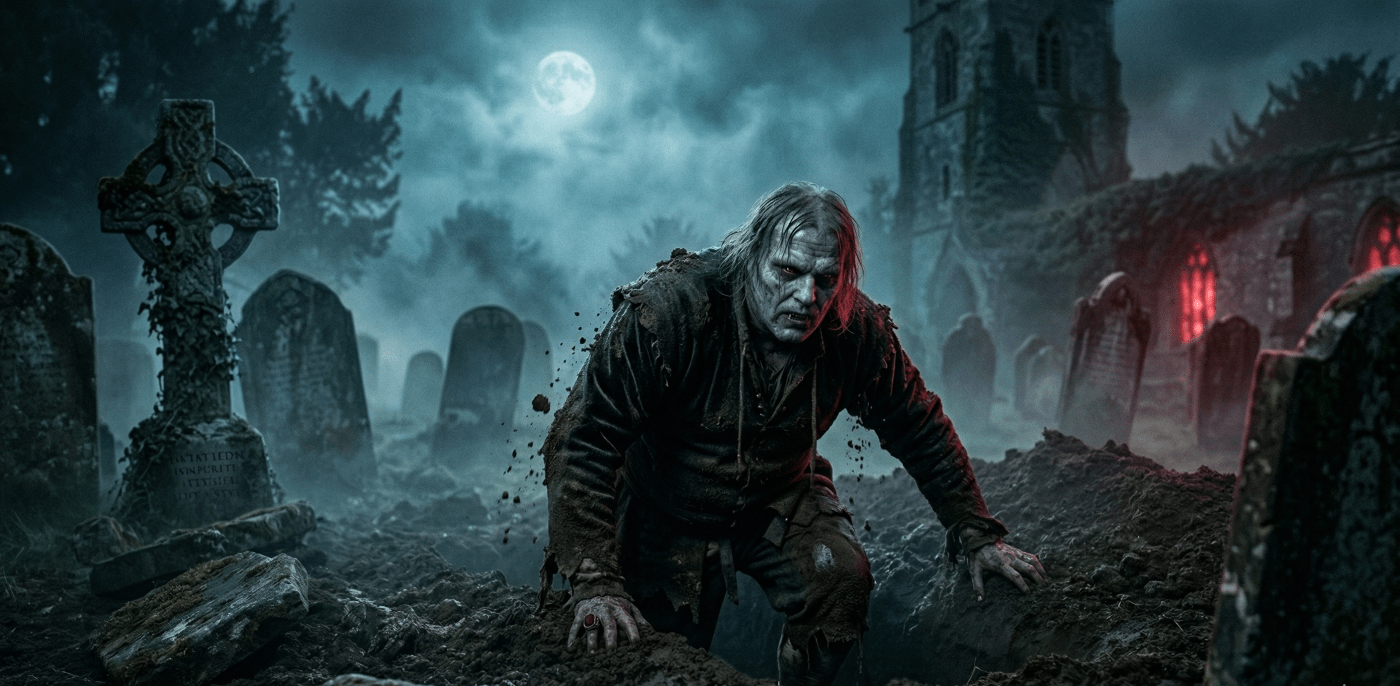
The man was buried, and not long after, there were sightings of him wandering the courtyards of the castle and surrounding streets pursued by a pack of howling dogs, whereupon he would attack innocent folk, beating them black and blue. Mass hysteria followed, leading the locals to barricade their doors at night for fear of being his next victim.
Then came disease.
It was said that the creature poisoned the very air with its breath, bringing about a plague the likes of which the town had never seen. People died in great numbers. Those who survived fled.
Grieving the loss of their father to the plague, two brothers resolved to end the revenant’s hold over their town. Armed with spades and pitchforks, they entered the cemetery under cover of darkness … and what they found confirmed their deepest fears.
The word ‘vampire’ would not be used until centuries later, but that was exactly what the brothers believed they had found.
The body lay in a shallow grave, its shroud torn to pieces. It had not decayed but was instead grotesquely swollen – bloated to almost twice its natural size as though engorged with blood.
The brothers dragged the body away from the town, where they proceeded to hack it open. Fresh, hot blood gushed from the corpse as one of the brothers reached in and removed the heart. They then proceeded to tear the heart to pieces before burning it, along with the rest of the corpse, until only ash and bone remained.
It’s not clear what happened with the bones, but it was said that once the corpse was destroyed, the air cleared and the plague began to fade.
William of Newburgh had also recorded another similar account, of the so-called ‘Berwick Vampire’—a wealthy man from Berwick-upon-Tweed who rose from his grave to hunt for blood, also accompanied by a pack of howling dogs, and also blamed for a devastating plague that consumed the town. Just like the revenant of Alnwick Castle, his body was cut up and burned.
Accounts like these were not uncommon in medieval England, where fear and terror were often directly related to religious non-conformity. Today, the bloated bodies can be explained by modern science, but what of the sickness that followed? Or why it ceased the moment the revenants were destroyed?
Perhaps what is most unsettling about the Revenant of Alnwick Castle is not the corpse itself, but the belief that surrounded it. In the medieval world, fear had a shape. It walked the streets. It could be dug up, cut apart … burned. There was a solution, albeit a brutal one.
Today, our fears are different. Less tangible. Harder to name.
We no longer blame the dead for disease or misfortune, yet we still fear something is out there. Something watching … waiting … observing. Could it be something more insidious than a vampire? Or merely a reflection of our own anxieties? Either way, whether in the 12th century or today, it seems to me we are still trying to explain the unexplainable. Still searching for the same answers. And maybe it’s for this reason that these stories endure today, and will hopefully endure for many centuries to come.
Until next time ….
 EMERSON LAINE
Leave a comment