Churchyards and Crossroads is a series of blogs that explores stories, folktales, and ancient mythology that inspire my writing and the worlds I build. I hope you’ll walk them with me.
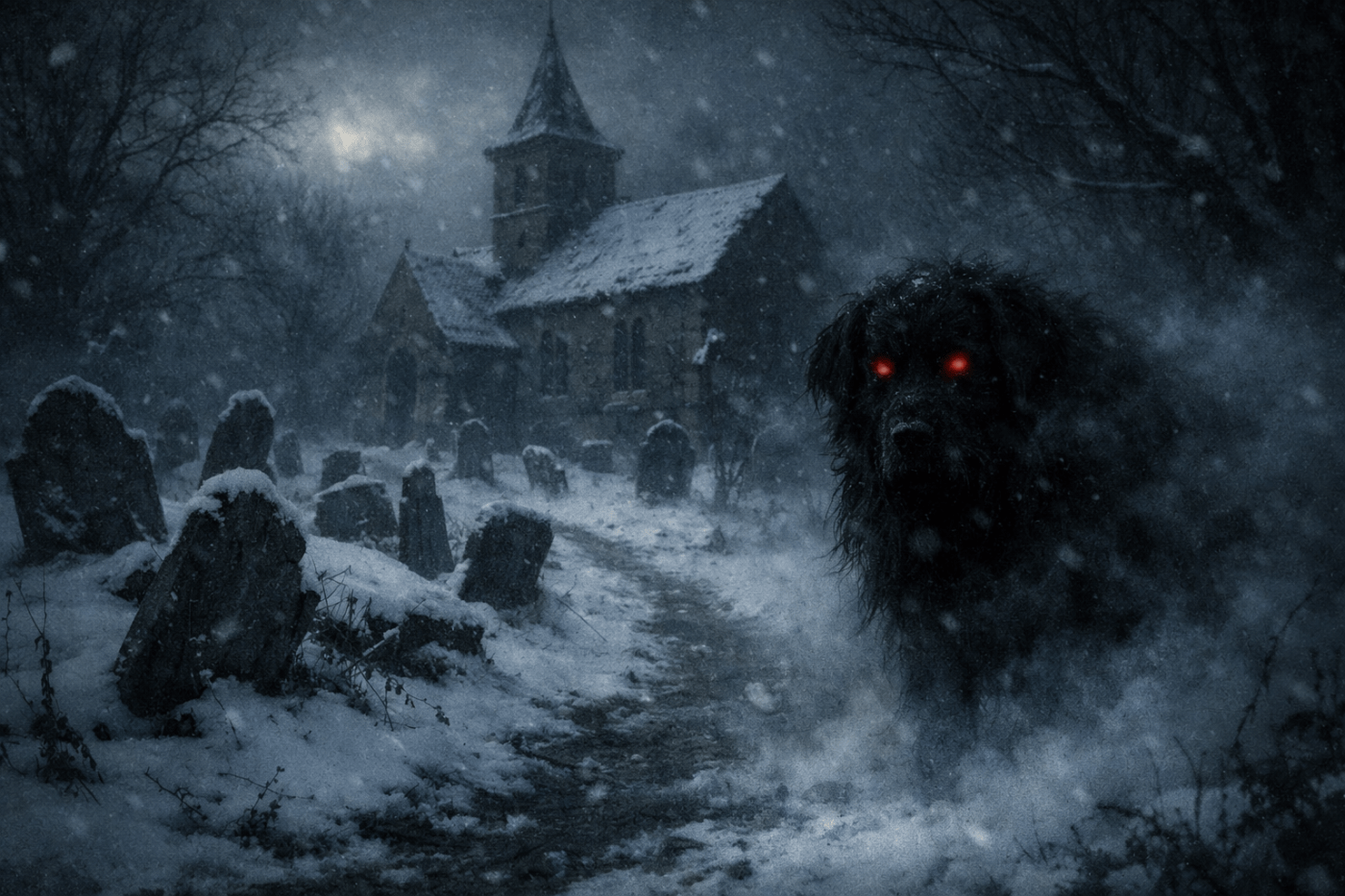
In British folklore—particularly in the north of England—few stories are as enduring or unnerving as tales of the barguest, also known as the Black Dog or Black Shuck. A large creature that resembles a great hound, with coal-black fur, eyes that glow like embers, and a presence that seems to drain the atmosphere of all warmth.
Descriptions of the barguest vary from region to region, with some even describing it as being the size of a horse, but the essence of the creature remains the same—terrifying to behold and bound to death, whether as omen, witness, or harbinger. It is said that to encounter the beast is rarely a blessing, as those who see it are often marked by misfortune, illness, or death.
Across England, there have been many sightings of the shaggy-maned menace, who reputedly leaves no paw prints after his (or her) visit. One story from a small town in East Anglia claims the demon dog burst through the doors of the parish church on the night of a violent storm in the year 1577. It was said to have arrived on a clap of thunder, upon which it sank its teeth into two parishioners, killing them both before leaving through the north door. Scorch marks from its hasty departure—aptly named ‘The Devil’s Fingers’ by the locals—can still be seen to this day at the Holy Trinity Church in Blythburgh.
One of the earliest recorded accounts of an encounter with a mysterious black dog was in 1127. An entry in the Anglo-Saxon Chronicle written by the monks at Peterborough Abbey describes terrifying events that occurred after the arrival of a new abbot, Henry of Poitou. The translated text describes wild hunts featuring a great number of black-clad, hideous huntsmen and jet-black hounds with eyes ‘like saucers’, seen by many and heard by many more.
In Manchester, the black dog was even said to be headless!
There are many tales of ghostly or demonic black dogs across Britain, and many stories were inspired by these hellish creatures, not least of all The Hound of the Baskervilles, or my own interpretation of the black dog—the Grymlock—which appears in Augustine. Even Dracula was said to have shifted into a black dog on his arrival in England, leaping from the shipwrecked Demeter to seek refuge in a church graveyard.
Witches, though more commonly portrayed as having a black cat as a companion, are also connected to the infamous black dog throughout history. In modern-day tales, a witch’s familiar is a feline creature, but the barguest also surfaces repeatedly in accounts from the witch trials of the 16th and 17th centuries. Accused ‘witches’ were often said to keep a familiar spirit, frequently described as a black dog with unnatural eyes that acted as messengers between worlds.
But the barguest isn’t only described as a demonic creature. Some believe it to be a guardian—a spirit bound to old families, appearing when bloodlines were threatened. Or a restless soul trapped between worlds, condemned to walk the earth in animal form.
Whether you believe the barguest to be a watcher, a herald of something terrible to come, or simply a guardian, protecting a precious bloodline, perhaps consider this: the demonization of the barguest may say less about the creature itself and more about a society desperate to control death, magic, and the unknown. Whether omen, guardian, or echo of ancient belief, tales of the barguest endure today—maybe because, although we fear it, we need the idea that something stands watch at the threshold between life and death. Or maybe, just maybe, the barguest is no myth, but a creature that guards the veil between worlds as it has done for centuries, and will likely do for many more to come.
In the next entry of Churchyards & Crossroads, I’ll explore another figure that waits where paths converge—one less familiar, but no less ancient.
Until then …
Keep to the path—and steer clear of the shadows!
 EMERSON LAINE
Leave a comment