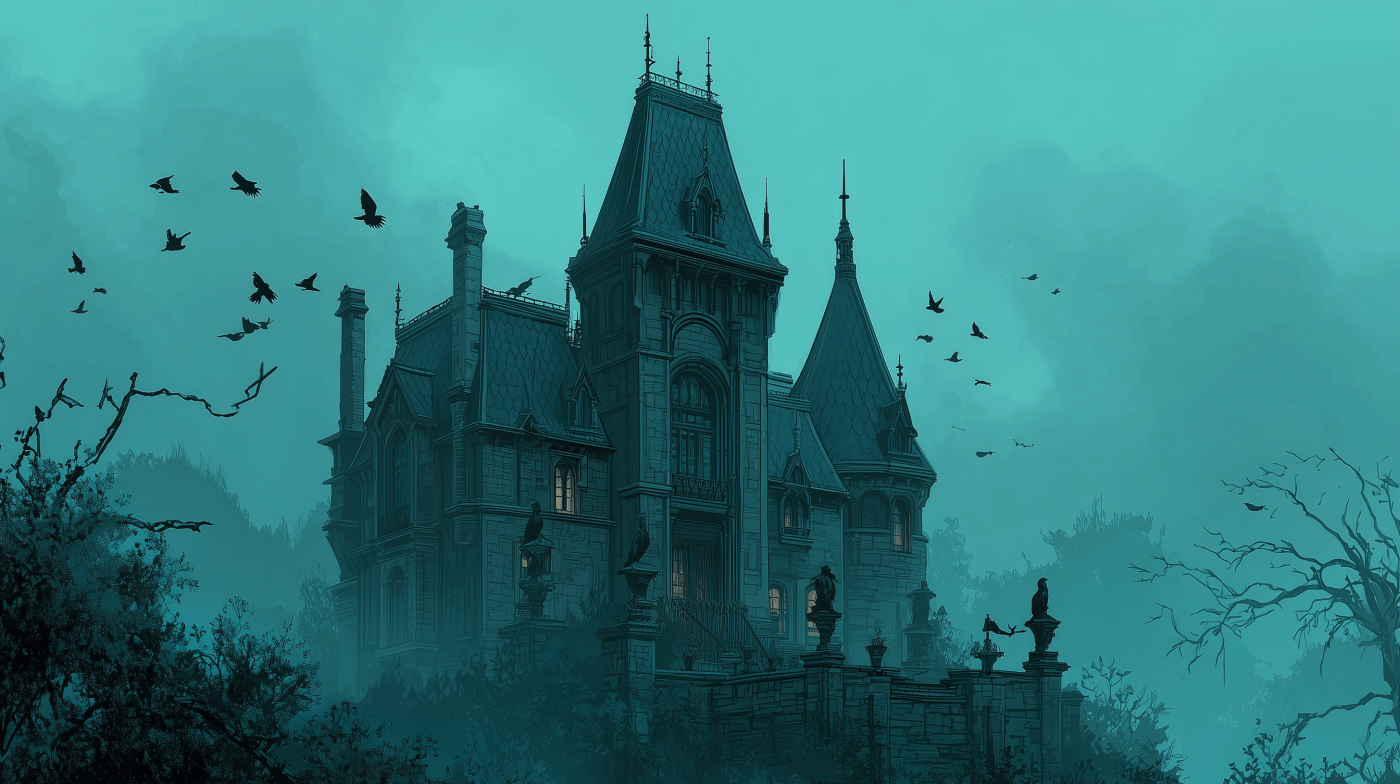
Where grief lingers in the walls, and the dead are never truly gone.
There’s a certain kind of house that lives long after its last occupant has gone. Where its floorboards creak not from age, but from memory. Where silence is not peace, but a warning. We’ve all seen them. Watched them in movies. Read about them in books.
At the heart of Augustine is a renovated estate shrouded in myth and folklore. Carrion Hall is more than just a setting—it’s a character in its own right. A keeper of secrets.
But what makes a house ‘gothic’? And why did I choose to build the story of Augustine around one?
Inspirations
As with ‘The Hat Man’, I have my own personal experience to draw on for Carrion Hall, though to a much lesser degree.
I was very young when The Hat Man came to visit. We lived in an old house—or at least a house that I now perceive was old (we had an outside loo!)—and The Hat Man wasn’t the only thing I would see lurking in the shadows. Without going into detail here, my first home lives in my mind as a haunted house. Not a mansion, just a simple two-up two-down terraced house on a cobbled street.
But it’s where Carrion Hall came from.
From Wuthering Heights to Crimson Peak, the gothic mansion is a literary archetype—looming, weathered, and laden with psychological and supernatural weight. These houses don’t just contain horror, they generate it—from creaking staircases, locked doors, strange cries in the night, and the sense that someone—or something—never left, and in designing Carrion Hall, I wanted to draw on those classic motifs, to integrate my own memories of a haunted house, and also to reimagine them for a darker fantasy world. By including Evie’s tower, the grimacing gargoyles, tall windows, and steepled roof, I created my version of a Gothic haunted mansion. The carving of a crow mid-flight adds another layer of atmosphere and mystery.
The Hall as a metaphor
When I write, I rarely consider themes, or tropes, or even character arcs, though these are all solid foundations for writing. I just think about the kinds of things I love to read and try to incorporate them, and if I have personal experience to draw on, all the better. However, as with most writers, the theme will materialise all by itself.
Augustine was originally going to be a classic haunted house story, so the Hall was an integral part of that story. But while the bones of the house are still central to Augustine, the plot took a much more sinister turn.
Augustine explores magic, resurrection, and ancient cults, but at its core, it is ultimately a story about grief, legacy, and identity.
- Ancestral burden: the weight of secrets passed down.
- Sorrow in stasis: a house frozen in time, much like the characters caught between past and present
- Transformation: both spiritually and bodily – as portrayed by the Hall’s renovation and the characters that move through it.
While some of the above may not be glaringly obvious in Augustine during your first pass, the clues are there.
Carrion Hall and the Animus Mundi Legacy
In Augustine, we see the newly renovated Carrion Hall with a glimpse at the horrors that still cling to the floorboards. But as the series The Knights of Aster progresses, we delve into the Hall’s dark and murky past, and the morally grey characters who have passed through it. Characters that—at some point—will bleed into my other series, The Rise of the Nephilim.
Carrion Hall is not merely haunted. It’s sacred.
Built atop ancient ground, the Hall’s foundations are laced with ritual and blood.
To quote a line in Augustine, ‘there is much more to Carrion Hall than just bricks and mortar.’
So, if you’re drawn to the eerie beauty of gothic fiction, Augustine may feel like a familiar, but unsettling, invitation. And if you want to know what or who lies beneath the foundations, I suggest you click ‘follow’ to be notified when book two of The Knights of Aster is out.
At Carrion Hall, the lights may flicker
The air may chill
But the door is always open
 EMERSON LAINE
Leave a comment